
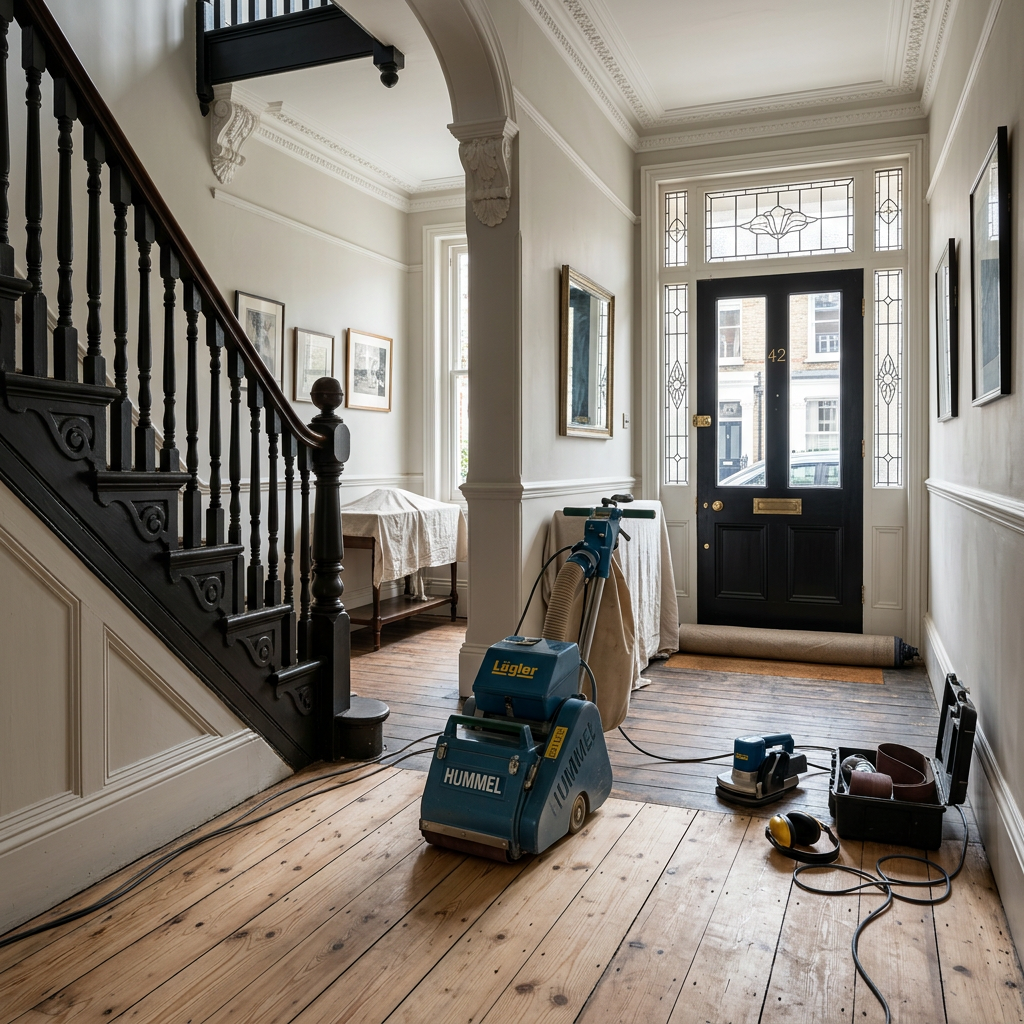
| Focus | Victorian Pine Heritage Restoration |
| Key Technology | Lagler Hummel Dust-Free Sanding & Zirconia Abrasives |
| Primary Finish | Bona Traffic HD (Anti-Slip) |
| Local Impact | Increases Tonbridge property value & thermal efficiency |
There is a unique architectural soul found within the Victorian terraces of Tonbridge. From the red-brick facades near the High Street to the grander townhouses overlooking the Medway, these period properties share a common, often hidden, treasure: original pine timber floorboards. For many homeowners, however, these heritage features are currently a source of frustration rather than pride. They are frequently buried under decades of synthetic carpet, suffocated by thick bitumen, or left to gape, letting in chilly draughts that send heating bills soaring through the roof.
The Problem: Tired Timber and Tonbridge Draughts
Owning a Victorian home in Kent comes with a specific set of challenges. Period timber, while beautiful, is a living material that has endured over a century of seasonal movement. In the damp UK climate, original floorboards often suffer from high moisture content issues, leading to cupping or crowning. When you peel back an old carpet in a TN9 property, you aren’t just met with dust; you’re often facing a floor that is structurally sound but aesthetically exhausted. The varnish is usually a brittle, orange-hued shellac that has flaked away in high-traffic zones, leaving the raw timber vulnerable to grey water staining and deep-seated grime.
The biggest issue for many is the ‘gap.’ Victorian houses weren’t built with modern insulation in mind. Those 5mm to 8mm gaps between your boards act like miniature wind tunnels, pulling cold air up from the crawl space. This doesn’t just make the room uncomfortable; it’s an expensive inefficiency in an era of rising energy costs. Furthermore, the aesthetic ‘agitation’ of a scratched, patchy floor can bring down the entire design of a room, making even the most expensive furniture look out of place against a backdrop of neglected heritage timber.
The Solution: Professional Wood Floor Sanding in Tonbridge
Restoring these floors isn’t merely a cosmetic upgrade; it is an act of heritage restoration. By choosing professional wood floor sanding Tonbridge services, you are employing a meticulous process designed to stabilize, flatten, and seal your history. We don’t just ‘sand’ a floor; we re-engineer the surface using industrial-grade machinery like the Lagler Hummel and the Bona Flexisand, ensuring that the process is virtually dust-free.
Pro-Tip: The Grit Sequence for Victorian Pine
Victorian pine floorboards are softer than oak but often more uneven. For a successful restoration, we typically start with a 40-grit Zirconia abrasive. Why Zirconia? It stays sharp longer and cuts through old bitumen or lead-based paints without overheating the wood. If the floor is particularly ‘cupped’ (the edges are higher than the centre of the board), we may even start at a 24-grit on a diagonal pass to level the field before moving into the grain-aligned passes. We then progress through 60-grit and 80-grit, finishing with a 100-grit or 120-grit screen to ensure the surface is perfectly smooth and the grain raising is kept to an absolute minimum.
The Technical Nuance of Gap Filling and Repairs
To solve the draught issue, we utilise a two-pronged approach to gap filling. For hairline fractures and small gaps (under 3mm), we mix the fine ‘flour’ dust from the 80-grit sanding pass with a high-quality resin. This creates a colour-matched paste that flexes with the floor. For the larger, classic Victorian gaps, we use reclaimed pine slivers. These are tapered strips of timber that are glued and hammered into the gaps, then sanded flush. This structural repair doesn’t just stop the wind; it makes the floor feel solid underfoot, eliminating that ‘spongy’ sensation common in old Kentish terraces.
Finishing with Precision: Bona Traffic HD vs UK Humidity
Once the sanding is complete, the timber is at its most vulnerable. In Tonbridge, where humidity levels can fluctuate significantly near the Medway, choosing the right seal is vital. We often recommend Bona Traffic HD for residential hallways. It is a water-based lacquer that offers incredible durability and a ‘Commercial’ grade resistance to scratches.
Technical Insight: Before applying the lacquer, we often perform a ‘water popping‘ technique. This involves lightly misting the floor with de-ionised water to open the wood pores. This ensures a deeper penetration of the primer and prevents tannin pull—a common issue where the natural acids in the wood react with water-based finishes to create dark, patchy blotches. We typically apply one coat of primer followed by two to three coats of Traffic HD. In UK humidity (typically 50-70%), we allow 2-4 hours between coats, ensuring each layer is fully cured before the next is applied.
Why Local Expertise Matters for TN9 Homeowners
Hiring local tradesmen who understand the specific timber stock of the South East is essential. We have spent years perfecting parquet floor sanding in Tonbridge and plank restoration, ensuring that every project respects the age of the building. We also ensure all our pricing is transparent, including VAT, so there are no surprises for our domestic clients.
Conclusion: A Heritage Investment
A restored Victorian floor is more than just a surface; it’s a centerpiece that adds significant value to your Tonbridge home. By following a disciplined sanding sequence, addressing structural gaps, and sealing with premium products like those from Bona, we ensure your history is preserved for the next century. Whether you are in a townhouse or a cottage, your floorboards deserve the touch of a specialist.
Ready to transform your home? Explore our wood floor restoration gallery or read our complete guide to floor sanding to see how we can bring your timber back to life.


