
School floor sanding in Tonbridge TN9
School floors in Tonbridge TN9 take a harder beating than most commercial timber. Assembly chairs are dragged across halls, grit comes in from playgrounds, sports shoes work the finish hard, cleaning chemicals attack tired lacquer, and dining or childcare areas see regular liquid spills. Once the protective seal has worn through, the problem moves beyond appearance: bare timber holds dirt, raised grain becomes difficult to clean, loose parquet can turn into a trip point, and an over-polished surface can present a slip risk.
We carry out School Floor Restoration in Tonbridge for educational buildings ranging from small nurseries and Victorian conversions to large secondary-school halls and multi-building campuses. Our work covers structural repairs, controlled sanding, gap treatment, commercial lacquering and planned School Floor maintenance in Tonbridge, with the programme built around lessons, examinations, lettings, holiday clubs and term dates rather than expecting the school to work around us.
Where a floor has already been sanded several times, the first question is not how quickly we can put a machine on it. We establish what timber is present, how much usable wear layer remains and whether School Floor Refinishing in Tonbridge can be completed without unnecessary loss of material. That distinction matters on old strip floors, parquet blocks and heritage boards where aggressive domestic-style sanding can do permanent damage.
Tonbridge has a mixed building stock. Around the High Street and its conservation area there are substantial 18th and 19th-century buildings, Gothic institutional architecture and older converted premises, while other TN9 education sites occupy post-war teaching blocks, modern academies and purpose-built sports facilities near the River Medway, Tonbridge Castle and the wider town centre. Those buildings can contain anything from quartersawn oak parquet and pitch pine boards to later beech sports flooring and modern engineered timber.
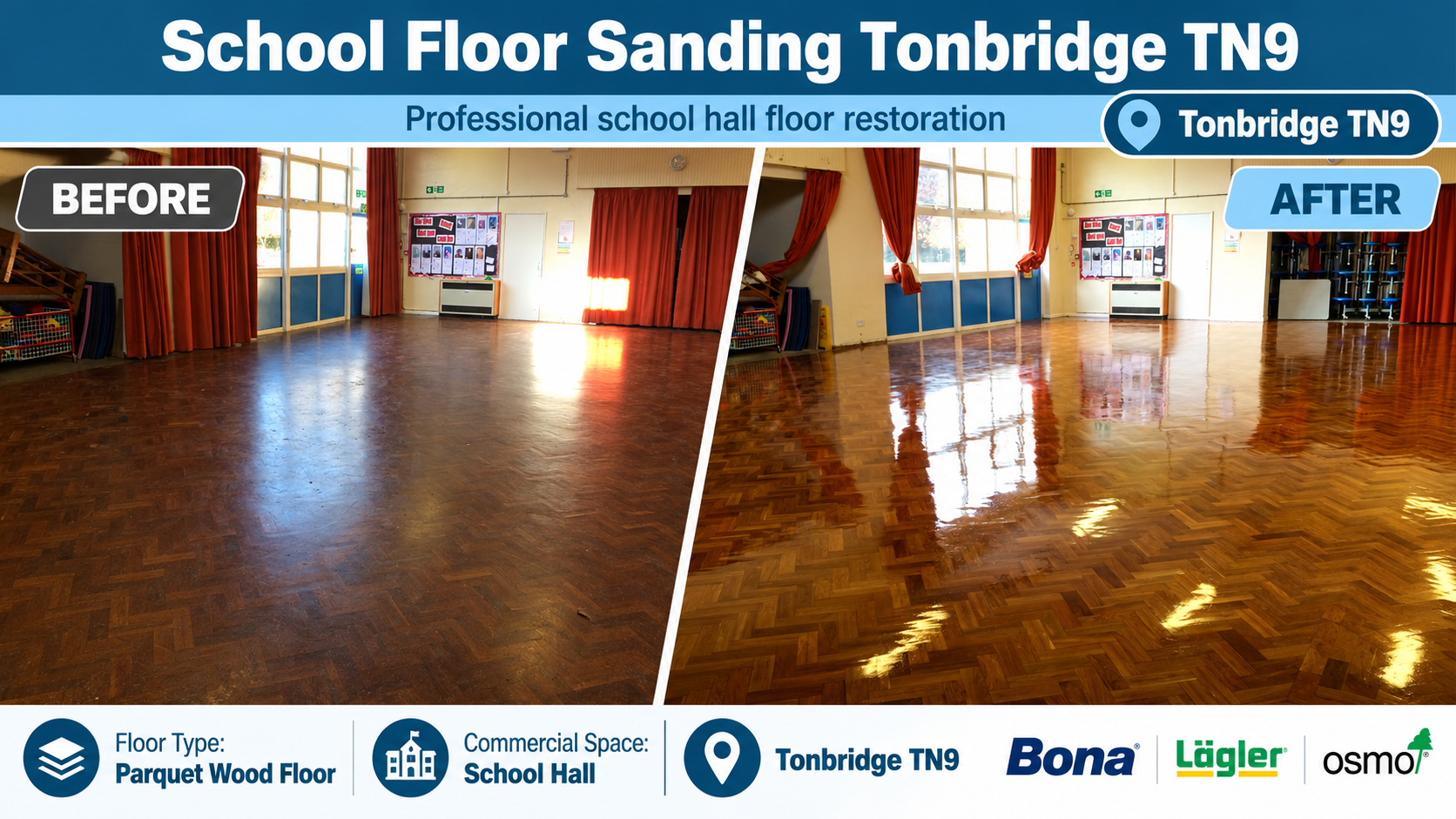
Before and after school hall floor restoration in Tonbridge TN9, showcasing the transformation of a worn parquet wood floor into a smooth, professionally sanded and refinished surface.
Educational Sites We Work In
Our school floor sanding work is planned for education rather than treated as an oversized domestic job. That includes safeguarding arrangements, segregated work areas, controlled access, noise planning, COSHH information and clear return-to-service times.
- Nurseries, preschools, kindergartens, childcare centres, daycare centres, Montessori schools and after-school clubs.
- Primary schools, elementary schools, secondary schools, high schools, academies, public schools, private schools, independent schools, boarding schools and international schools.
- Special education schools, tuition centres, tutoring academies, language schools, music schools, art schools and sports academies.
- Colleges, sixth-form colleges, vocational training centres, technical institutes and educational training facilities.
- Universities, higher education institutions, adult learning centres and larger educational campuses.
Why School Timber Floors Wear Differently
A school hall does not wear evenly. Door thresholds, serving points, assembly routes, chair-storage areas and the first few metres inside an entrance can reach bare timber while the centre of the room still carries a reasonable film of lacquer. Applying another coat of polish over that pattern may improve the shine for a few weeks, but it does not replace a failed protective film.
Domestic sanding methods are equally unsuitable. Taking heavy cuts simply to remove old coatings quickly can dish soft springwood in pitch pine, flatten the character from old oak, damage parquet tongues or leave visible sanding lines across a large hall under daylight. The sanding sequence has to match the timber, existing finish, floor construction and final coating system.
Species identification matters as well. Quartersawn oak behaves differently from resinous pitch pine, while teak and other naturally oily timbers need particular attention to surface preparation and coating compatibility. Pitch pine can resin-smear if it is overheated during sanding, and heavily tannic oak needs a finishing system that will not leave avoidable discolouration.
Common Structural and Safety Problems We Find
- Loose parquet blocks: movement creates clicking, rocking edges and eventual block failure under concentrated footfall.
- Open joints: uncontrolled gaps become dirt traps and can retain moisture from wet cleaning.
- Failed adhesive: old bituminous or brittle adhesive beds can release locally while surrounding blocks still appear sound.
- Raised board edges: moisture movement, loose fixings or subfloor distortion can create trip points.
- Over-polished surfaces: repeated use of unsuitable maintenance products can alter slip behaviour rather than restore the protective coating.
- Moisture ingress: leaking entrances, cleaning water, plumbing faults or a damp subfloor can cause cupping, lifting and adhesive breakdown.
- Excessive sanding history: older floors may have limited timber remaining above tongues, grooves or fixings.
- Incorrect gap filling: rigid filler placed into genuine movement joints can crack out or restrict necessary timber movement.
Our Commercial School Floor Restoration Process
Step 1: Subfloor Audit & Moisture Testing
Before quoting a substantial school floor, we inspect construction as well as surface condition. We look for loose boards, hollow parquet, deflection, failed fixings, previous sanding depth, adhesive breakdown, damaged thresholds, perimeter expansion provision and signs that moisture is entering from below or above.
Timber moisture readings are taken where required, and suspected screed or concrete moisture is checked with appropriate hygrometer testing before blocks are re-bonded. A lacquer will not correct a damp subfloor, and sealing moisture-related movement beneath a new finish usually produces a more expensive failure later.
On suspended floors we also consider ventilation and the condition beneath the boards where access permits. On parquet laid over screed, old bitumen, residual adhesive, laitance and localised hollow areas are assessed before specifying a new bonding system.
Step 2: Timber Repairs, Re-bonding & Resin Gap-Filling
Loose or damaged parquet is dealt with before sanding, not hidden beneath filler. Sound reusable blocks can often be lifted, cleaned and re-bonded; badly damaged pieces are replaced with compatible timber wherever a suitable match can be obtained.
For appropriate parquet repairs we use flexible silane-based adhesives rather than brittle general-purpose construction glue. Products in this class, including professional Bona silane adhesive systems, provide controlled elasticity, and selected products carry EMICODE EC1 Plus very-low-emission certification.
Fine stable joints can be closed using a resin-slurry made with clean sanding dust from the actual floor, giving a much closer colour relationship than proprietary coloured putty. Wide gaps, failed blocks and genuine movement joints are handled separately; we do not pour resin indiscriminately into every opening because timber still needs somewhere to move.
On old boards, timber slivers may be a more durable repair than filler where gaps are too wide for a slurry. Split tongues, projecting nails and insecure fixings are corrected before the final sanding passes so repairs finish flush with the surrounding floor.
Step 3: HEPA Dust-Controlled Sanding & Surface Preparation
For large school floors we use professional belt-sanding equipment such as the Lägler Hummel rather than lightweight hire-shop machinery. Its 200 mm belt and controlled drum pressure allow an experienced operator to level a worn floor progressively without leaving the waves and stop marks that become obvious once a large hall is lacquered.
The abrasive sequence is selected after the trial area. A badly cupped or heavily coated floor may need an initial coarse cut, while a reasonably flat floor can start finer and preserve more timber; subsequent passes remove the previous scratch pattern rather than simply making another pass for the sake of it.
Edges, radiator lines, door recesses and corners are brought into the same scratch sequence as the main field. Final surface preparation may include orbital or multi-disc finishing where required so the floor accepts stain, primer or lacquer consistently under strong side-light.
Extraction is connected to professional dust-control equipment with HEPA H14 filtration where specified by the site risk assessment. We describe the process as dust-controlled rather than pretending sanding produces no dust at all; timber dust is managed through extraction, housekeeping, enclosure, suitable respiratory controls and the measures set out in the project RAMS.
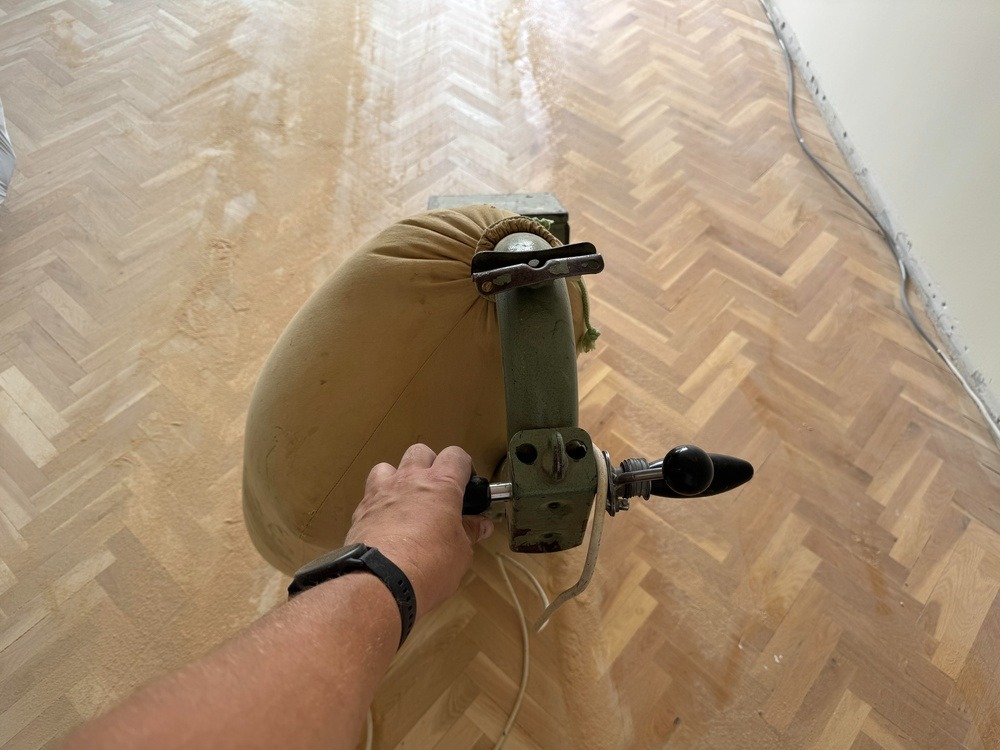
Professional parquet floor sanding in Tonbridge TN9, removing worn surface finishes and preparing herringbone wooden flooring for restoration in schools and educational buildings.
Step 4: High-Traffic Lacquers, Hardwax Oils & Slip Resistance
The finish is chosen around the room’s actual use. A reception route carrying hundreds of shoes each morning needs different treatment from a music room, historic board floor or assembly hall that doubles as a sports space.
For heavy commercial use we regularly specify 2K waterborne polyurethane technology. A two-component lacquer uses a measured cross-linking hardener or catalyst to form a tougher polymer film than a straightforward single-pack coating; the mix ratio, induction requirements, pot life, application weight and recoat window all have to be respected.
Bona Traffic HD, for example, is a professional 2K waterborne polyurethane coating designed for high-traffic floors. Bona states that the system can take full traffic after 12 hours under specified conditions, but practical school handover is always set against actual temperature, humidity, coat build, furniture loading and the intended use of the room.
Hardwax oil can be the better specification on some heritage boards or areas where localised future repairability is important. Osmo Polyx-Oil Anti-Slip is one professional option for timber requiring enhanced slip resistance, with manufacturer variants including R9 and R11 classifications.
Sports surfaces need particular care because excessive grip can be as undesirable as insufficient grip. Where slip performance forms part of the specification, we work to the agreed system and testing requirement rather than relying on a product label alone.
Some older school documentation still refers to the BS 7976-2 pendulum method. BS 7976-2:2002+A1:2013 was withdrawn in 2022 and superseded by BS EN 16165:2021; current projects requiring pendulum assessment should therefore be specified and tested against the current standard, with legacy requirements cross-referenced where necessary.
Step 5: Aftercare & Maintenance Protocols
A newly restored floor can be damaged quickly by the wrong maintenance regime. Strong alkaline cleaners, excessive water and repeated layers of generic metallised polish can interfere with the floor’s appearance, coating adhesion and slip characteristics.
At handover we set out the initial cure period, normal cleaning method and appropriate maintenance intervals for the finish used. Entrance matting, correctly fitted chair feet and prompt removal of grit do more for a school floor than repeatedly applying stronger cleaning chemicals.
For lacquered floors, periodic deep cleaning and a properly timed maintenance coat can avoid taking the surface back to bare timber every time. Oiled floors can often be refreshed locally or maintained with compatible oil before traffic wears completely through to raw wood.
Facilities teams can also review our floor sanding gallery for examples of completed work and visit the floor sanding prices page for an initial indication of costs. School and campus work is normally surveyed individually because repairs, access, phasing, line marking, furniture movement and finish specification can change the programme considerably.
Commercial Logistics for Active Schools and Colleges
The technical work is only half of a commercial education project. A perfectly finished hall that cannot be handed back before morning registration is not a properly planned job, so drying times, access routes, alarms, keyholding, caretaker cover and the next scheduled activity are agreed before mobilisation.
| Working Pattern | Operational Benefit | Typical Facility Suitability |
|---|---|---|
| Overnight | Noisy sanding and coating work is completed after pupils, staff and visitors leave. Areas can be isolated while other parts of the building remain operational. | Nurseries, tuition centres, colleges, universities, language schools and buildings with evening-to-morning closure periods. |
| Weekend Phased | Allows larger zones to be repaired, sanded and coated with a longer uninterrupted curing window before weekday traffic resumes. | Primary and secondary schools, academies, independent schools, administrative teaching blocks and multipurpose halls. |
| Sectional | The floor or building is divided into controlled work zones so essential operations can continue elsewhere on site. | Universities, colleges, boarding schools, educational campuses and facilities that cannot close completely. |
| Half-Term / Holiday Shutdown | Provides the best window for extensive parquet repairs, full sanding sequences, multiple coating stages and proper cure before furniture is returned. | Large halls, sports floors, extensive corridors and full-building refurbishment programmes. |
Cure time must not be confused with touch-dry time. A coating may be ready for another coat or careful light access long before it is ready for chair stacks, wheeled staging, sports equipment or hundreds of pupils crossing it at once.
Where an accelerated system is justified, we select it at quotation stage rather than trying to shorten cure periods on site. Temperature and relative humidity are recorded where they affect the coating programme, and ventilation is controlled without introducing airborne dirt into a wet finish.
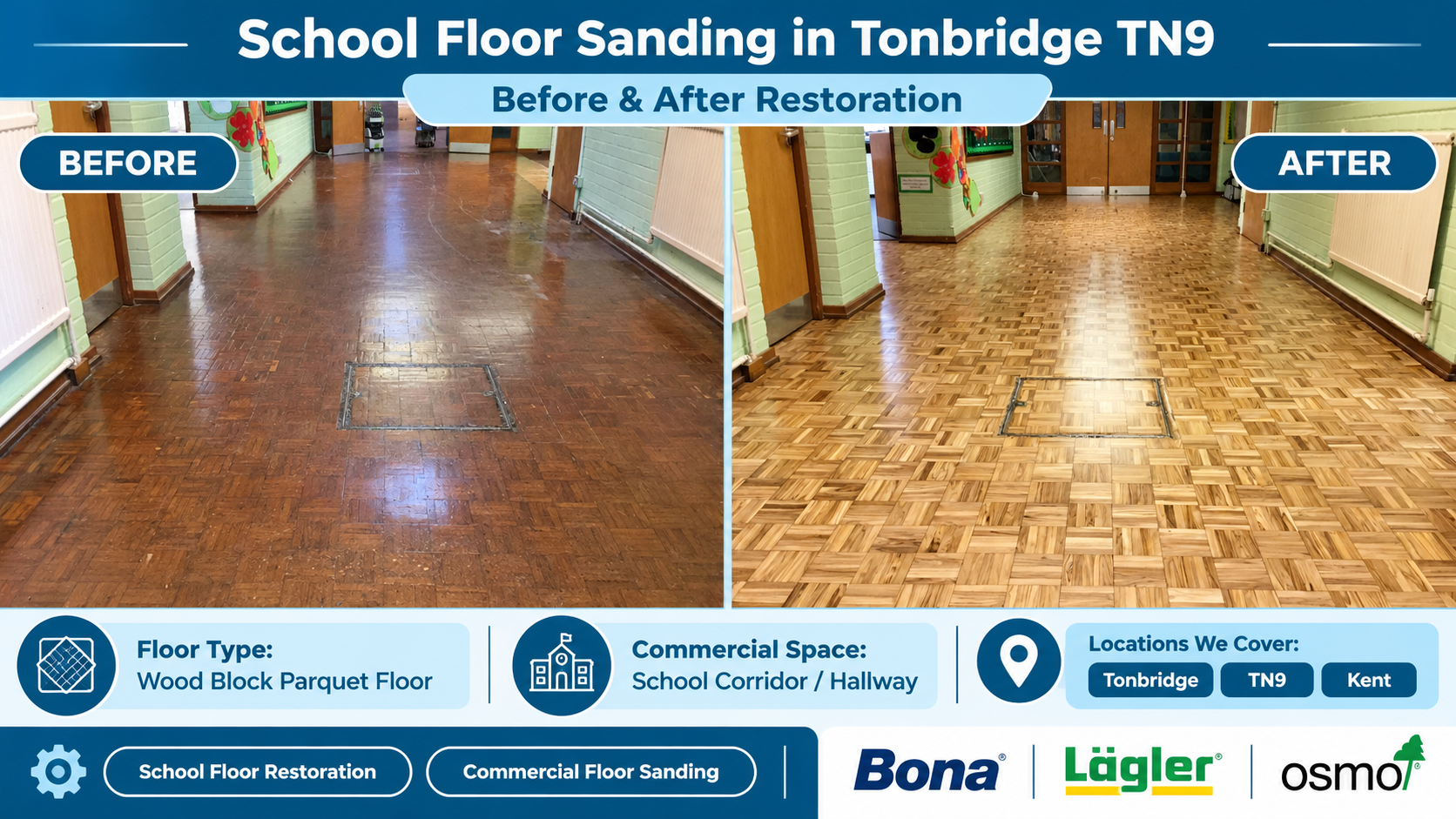
School Floor Sanding in Tonbridge TN9 – Before and after transformation of a commercial school corridor with restored wood block parquet flooring, featuring professional sanding and refinishing.
RAMS, COSHH and School-Site Safety
Commercial education work is carried out under site-specific RAMS rather than a generic domestic checklist. Documentation can cover access and egress, exclusion zones, electrical equipment, noise, manual handling, timber dust, coating materials, waste, emergency procedures and coordination with the school’s appointed site contact.
COSHH assessments and relevant Safety Data Sheets are considered for fillers, primers, adhesives, lacquers, hardeners and maintenance chemicals. Where low-emission materials form part of the project brief, products with recognised classifications such as EMICODE EC1 Plus can be specified where the individual product and application allow.
Wet coatings, exposed repairs and machinery are isolated from pupils, staff and other trades. On occupied or partially occupied sites we agree barriers, signage and safe routes before work starts, rather than attempting to manage segregation once sanding equipment is already running.
Why Estate Managers Use a Specialist Floor Contractor
A school floor survey should result in a usable scope of works, not a vague price for “sand and varnish”. We identify repairs separately, state the proposed sanding and finishing system, discuss anticipated cure periods and flag any area where opening-up may expose additional work.
Our commercial arrangements include CSCS-carded site staff where required, project RAMS, COSHH documentation and commercial liability insurance. The Tonbridge Floor Sanding website currently records £5 million insurance cover, giving site managers a clear point to verify during contractor onboarding.
For an initial assessment, clear photographs and a slow video walk-through are often enough for us to understand floor size, general condition, access and obvious repair zones. A physical site survey then allows us to inspect moisture, floor construction, loose areas, previous coatings, power access and programme constraints before the final commercial quotation is agreed.
If you are preparing budgets first, the prices page gives useful starting information. For larger school halls, sports floors and multi-room programmes, measured quantities and an on-site inspection produce a far more reliable figure than pricing from square metres alone.

Arrange a School Floor Survey in Tonbridge TN9
If your hall, classroom, sports floor or parquet corridor is showing bare patches, loose blocks, heavy scratching or a failing lacquer film, send us photographs, a short video and any available floor plans. We can review the basic scope before arranging a physical survey and planning the work around your school calendar.
Call 0800 335 7565 to discuss the floor with our Tonbridge team. Site photographs and plans can also be sent through WhatsApp or email when you make your enquiry.


